
Trust Games
© www.games4youthgroups.com
Trust games usually make sense once the members of a group know each other a little better or when mutual trust and confidence in each other should be encouraged. Direct feedback, reflection on the games and the experiences can be done as a conclusion.
Trust games are an important factor when you playfully try to merge a group. This can happen as part of youth work, but also in the professional practice in terms of team building.
Many of these trust games have something to do with seeing or not seeing; it is about "blind trust". There are, for example, games in which a participant is blindfolded or gets a pair of specs with opaque glasses. Therefore, the person cannot see clearly any longer and depends on the other members to catch him before he falls. In this particular game, the “blind” person has to fall backwards, trusting that the other catch him before he hits the floor. In other games, the participants must lead a “blind” person through an obstacle course or alternatively, give correct instructions to the blind person to get through a maze. All these games are designed to trust statements and actions of other people. Particularly for children and adolescents, it is crucial to have confidence not only in their parents but also to their peers. To build this trust, the following games are excellent.
Confidence and Trust
Trust can show in a variety of forms. First of all, children should learn to build trust - i.e. to trust themselves in every possible situation. Everyone who has faith in oneself has it later in life - whether for business or pleasure - usually much easier. Confident people are not plagued by doubts or afflicted by depression. They proceed with courage and joy through life and, therefore, attract a lot of people.
By the way: If you can trust yourself, you are much more likely to trust others as well. That doesn’t come as a surprise. You must be able to rely on your own judgement to assess somebody else. Someone doubting other people, ultimately, doubts himself.
Trust games are all games in which the participants’ dependent on each other. This may be the case in sports, but also in games like the treasure hunt, etc. If the tasks were solved efficiently and timely, the participants will not just trust each other, but also themselves more after such a successful completion of the game.


 Supporting Hands
A member of the group is held and carried by the others.

 Transport the Injured
An injured person is carried by his friends.
- Zigzag Circle
Mutual trust and mutual support - this is the only way to success.
 Finding the secret entrance
How do I get into the group?
- Push the emergency button
How do I get the group under control?
- Fall Back
One player lets himself fall backwards and is caught by another player.
- The Tickle Game
The team doing the tickling must guess who is being tickled.
- Group and Outsider
The group learns that even outsiders belong in the group and contact shouldn’t be avoided.
- Balloon Trip
Group relationships and the role of the individuals in the group can be clearly noted.
 Nature Blind Touch
While blindfolded, the blind person receives assistance from his partner.
- Cat and Mouse
Cat and mouse are blind-folded and have a trainer who directs them by clapping hands or snapping fingers.
- Leading the Blind
One person is blind-folded and is tied with four long ropes that are held by four players.

 Horse with blinkers
A obstacle course is completed on piggy back. The "horse" is blindfolded. The horse receives instructions from the rider with thigh pressure.
- Double statue
The blindfolded partner tries to copy the same position.
- Banging your head against the wall
The players holds a blanket tense. One players tries to break through the wall.
- Sleeping mummies
A player is brought back to life from under the blanket.
- Blind snake
The blindfolded players hold hands. Only the head of the snake can see and shows them the way.
- Leading the Blind
One person is blind-folded and is tied with four long ropes that are held by four players.
- Mine Fields
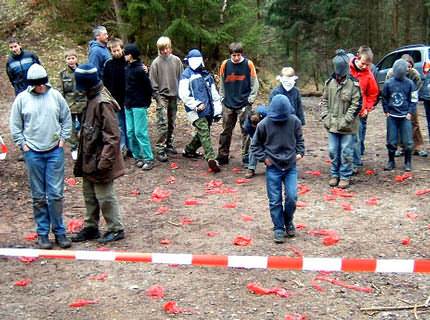
One partner is blind-folded and must walk through a 'mine field'.
 Rope spider
A player lies on a spider's web of ropes and is lifted up.
- Fake fainting
A game where it's all about trust and catching one another.
 Blind in the forest
While blindfolded, finding other kids and come together to one big chain
- Blind guides
The seeing guides try to lead the blind people in any way possible through the room.
- Leading the blind over a hurdle course
The seeing guides leading the blind people through an obstacle course.
[ © www.games4youthgroups.com ]